Specifications
Price: £229.00
Magnification: 25x
Objective lens aperture: 100mm
Focusing: Individual focus eyepieces
Eye relief :18mm
Field of view: 2.5degrees
Close focus: 80ft
Prisms: BAK-4, Porro
Anti-reflection coatings: Fully multi-coated
Eye-guards: Fold-down, rubber
Weight: 10lbs 2oz
Length: 17.3 inches
Barrel support: Brace rod
Tripod compatibility: Fits standard photo tripods via integral mount post, balance adjustable
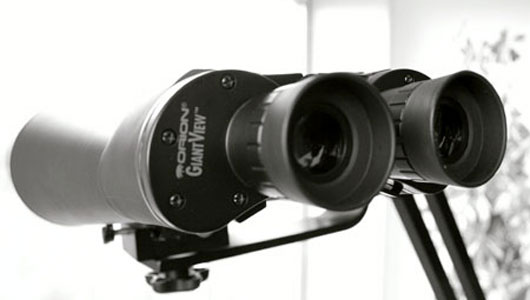
The large-aperture, fully multi-coated optics provide exceptional light gathering capability for stargazing. For terrestrial observing, you will appreciate Explorer's long-distance range, wide field of view, and stunning resolution.
These are well made binoculars featuring BAK-4 prisms and internal baffling. The barrels are cross-reinforced with an aluminum rod and objective cell cuffs for maximum structural rigidity and unflinching optical alignment. A sliding 1/4"-20 steel mounting post is held captive on the rod for coupling the binocular to a tripod (recommended) and achieving optimum balance via the knurled knob. In my opinion this should have been made from steel rather than from aluminium as the steel will strip the thread off the knurled knob!
,
The eyepieces focus individually out to infinity (the individual settings are shown on each eyepiece for convenience) which affords a higher degree of focusing precision than center-focus mechanisms. The eyepieces have an 18mm eye relief and each has an eye-guard that can be lowered to allow easy use by people who wear glasses.
Viewing
I use the Orion for deep sky objects and comet hunting due to the substantial light grasp and low magnification giving you good contrast. The Orion Giant-View are a perfect way to help you familiarise yourself with star-fields and the 2.5 degree field of view really makes it easy to hunt down those elusive nebulae. M101 the spiral galaxy in Ursa Major at mag 9.6 to M97 The Owl Nebula in Ursa Major at mag 12.0 will give you an idea of what can be observed in the way of feint objects. M42 The Orion Nebula is just stunning, while open star clusters are well resolved and will titivate a night's viewing! On the brightest of stars there would seem to be a little scattered light. The Moon is just awesome during one of its phases, showing you splendid views of its craters and even ripples in its Mare.
© Graham Green - HantsAstro 2008